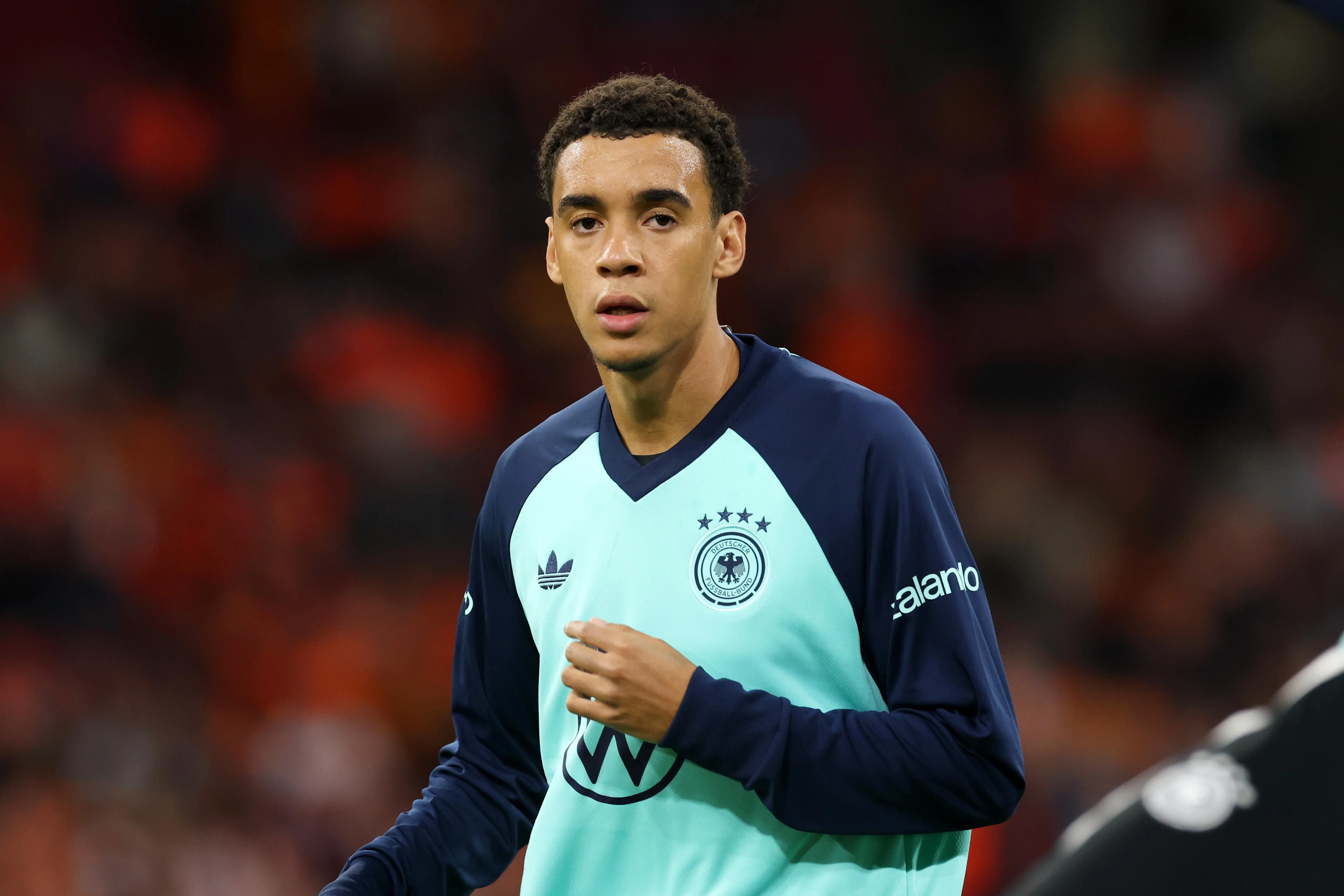
(Photo by Alexander Hassenstein - UEFA/UEFA via Getty Images) | UEFA via Getty Images
A talent nobody doubts, and a body that keeps letting him down
Jamal Musiala has become the awkward center of a conversation Bayern Munich didn't want to have this publicly. Nobody inside the club questions his ability. The problem is his availability. The 22-year-old keeps getting hurt, and that's raised a question that's harder to answer than any tactical one: can he stay on the pitch long enough to become what everyone expects?
That question got louder after Uli Hoeneß and Jan-Christian Dreesen made comments about the situation. Head coach Vincent Kompany and sporting director Max Eberl have responded by insisting the club still believes in him. Their message is clear. Whether it's convincing is a different matter.
Kompany's bet: make this his story
Kompany has taken the issue on personally. In his view, helping Musiala through this stretch is now part of his job, and he frames it as a question of role. "The real question is: What is my role?" he said. His answer: make sure every player at FC Bayern succeeds and gets the best out of himself. He pointed to Harry, who has since won the Ballon d'Or, as evidence that the staff's work pays off sometimes. Kompany's own phrasing was "My responsibility is to make sure that Jamal is successful at Bayern Munich." (as captured by @iMiaSanMia)
The more interesting part of Kompany's argument is the idea that adversity might do Musiala good. He drew a sharp contrast with Musiala's early years at Bayern, when the young winger was almost untouchable, the "golden child" whom nobody could criticize, even mildly. Kompany's take is that the current phase is building something those easy years didn't: mental and physical toughness that matters over a long career.
Here's the thing, though. Kompany admits he can't talk this into working. "That can only happen on the pitch," he said. He's right, and it's the core weakness of the whole PR exercise. Press conferences don't heal hamstrings or restore rhythm. Kompany's six-month timeline, where he expects a "completely different story," is a promise that depends entirely on the medical staff and on Musiala's body.
Eberl on the injury record
Eberl addressed the doubts more bluntly. He said the leadership's motivation comes from protecting Bayern's long-term interests, and that the concern being voiced comes from a genuine place. He also said there's considerable confidence at Säbener Straße that Musiala can work through his difficulties.
Eberl also acknowledged the uncomfortable part of the record. Musiala hasn't yet had a stretch of three, four or five months where he could get back to full fitness and stay there. Eberl listed the sequence: an ankle injury, a difficult summer, and now a muscle problem sustained with the German national team. Before that muscle injury, he said, Musiala's development was going exactly the way the club had hoped. That's a telling detail. The talent was never the issue. The sequence of interruptions is.
Eberl pointed to pre-season, to what the staff has seen in training, and to Musiala's form since his situation became public as reasons for optimism. He also said he could sense that Musiala is "a completely different person now," dealing with circumstances nobody his age should have to handle. And he didn't dodge the other side of the ledger: "The other side of it is concern, and that is entirely legitimate." He added that the concern is shared across the club, because the situation involves an illness as well as injuries.
One club, two messages?
The public comments from different layers of Bayern's hierarchy have sounded, to some observers, like they're pulling in different directions. Kompany rejects that reading. "We don't have different opinions, we have different roles," he said. He insisted he has "100% respect" for the people above him and doesn't see their comments as a problem.
That's a neat line, and it might even be accurate. Still, a coach and a sporting director being careful about the same player in public is a signal worth noticing. Kompany's tone is more emotionally invested in Musiala, while Eberl's is more defensive about the club's long-term exposure. Neither version is wrong. But when the people managing a player start sounding like they're managing a narrative, that's usually because the narrative needs managing.
Kompany's last point is the most tactically pointed. He argued that the club can turn Musiala's situation into a sporting advantage, since there's little that motivates a player more and the pressure is lower than it was during the golden-child period. Read the sentiment generously and it's a sound coaching instinct. Read it skeptically and it's a coach looking for a silver lining in a player's injury problem.
The verdict: this comes down to minutes on the grass
Strip away the quotes and the situation is simple. Bayern knows exactly what Musiala can do when he's fit, and the training reports are good enough to keep everyone patient. But potential and strong sessions don't count for much when injuries keep cutting his progress short. The club's public backing matters, and it might keep the dressing room steady. It won't decide anything.
Bayern is betting on its midfielder, and that bet is only as good as his next run of uninterrupted football. Kompany wants this period to become a defining chapter. Eberl thinks Musiala has the resilience to make it one. Everyone else is waiting to see whether he gets the chance to prove them right.