The goalkeeper and the decision he hasn't made
Andorra goalkeeper Jesus Owono hasn't decided whether he'll go back to playing, and his club says that call is his alone. FC Andorra's Carles Manso confirmed the position on Thursday, days after Tenerife forward Jesus de Miguel died in hospital on 4 November, the day after a collision with Owono during a Spanish football match. That timeline matters. Owono isn't weighing a contract or a transfer. He's weighing whether he can stand between the posts again after being involved in an incident linked to a death, and no club can make that calculation for him.
Owono, who is Equatorial Guinea's goalkeeper, put out a statement through Andorra last week. He called the ordeal "the most difficult days of my life." That tells you where his head is, and it's why the club isn't rushing him. Statements like this are usually drafted with care, so every word carries weight. Here, the phrasing reads less like a press-office line and more like a man who hasn't yet found his footing.
Manso's message was simple. "What we have to do is support him in every way and be close to him. We will give him space so that he feels completely free to make any decision, whether he wants to return, when, or if he does not want to return."
Clubs rarely say that last part out loud. Most talk about availability, squad depth and the next fixture, and telling a player that not coming back is a legitimate option goes against the usual instinct to protect the team. I'd argue it's the right instinct here. Whether it holds up under the pressure of a dressing room that's still grieving is a different question, and one the club can't answer yet.
Right now, Owono is spending time with his family, friends and partner. Manso described the aftermath as a "very complicated situation to manage," and that's an honest read. Nobody can script the emotional fallout of a death linked to a match on the pitch. What a club can do is keep the door open and avoid putting a timetable on grief, and that's essentially what Andorra has chosen to do.
"When he feels it is appropriate and when he feels genuinely ready to take a decision like that, he will do so," Manso added. Read that twice. The sentence leaves out deadlines, selection plans and any hint of pressure. For a goalkeeper, whose job depends on sharp reactions and trusting his body in a split second, the question of readiness isn't a formality. It's the whole thing.
Owono has 47 caps for Equatorial Guinea, but he wasn't called up for his country's doubleheader with Zimbabwe during this international break. Whether that was purely a timing decision or a sign of his state of mind, the club hasn't said. Squad lists are usually put together with some lead time, so the omission could mean almost anything. Read too much into it and you're guessing. Read too little and you might miss the first real signal of where he stands.
A farewell in Tenerife
Andorra play Almeria on Saturday, their first fixture since De Miguel's death. It will be the first real test of how the squad handles that absence without him. Football fixtures don't pause for grief, and that's the uncomfortable reality any squad in this position faces. Players are asked to refocus within days of losing a colleague, and whatever they say publicly, the match will show how far that process has actually moved.
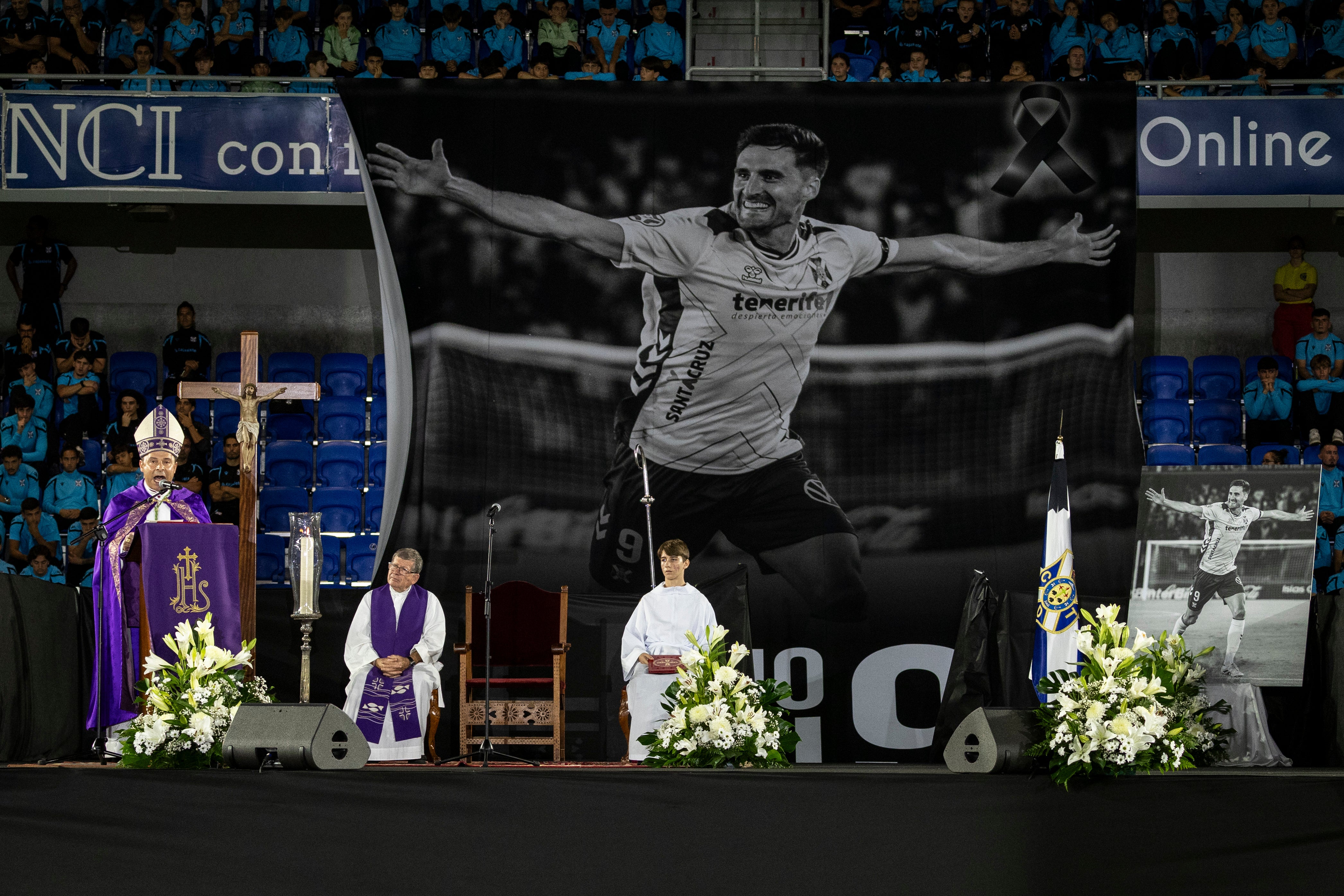
Over the weekend, Tenerife's players and thousands of fans paid an emotional final tribute at the club's stadium. A large banner showing his black-and-white photograph and the words "Forever Demi", a nod to his nickname, hung behind a central stage at the Estadio Heliodoro Rodriguez Lopez. Tributes like this follow a familiar pattern in football, but the details are what make them land. A nickname on a banner and a debut video shown to the crowd suggest the club wanted supporters to remember the person, not just the name on the team sheet.
After a video of his Tenerife debut played, supporters chanted "De Miguel, we love you". Players sat alongside representatives from every club in Spain's top two divisions, including Real Madrid director Emilio Butragueno, as tears fell in the stands. That's a striking sight in a sport where clubs are usually rivals first. Seeing those representatives share the same space is the kind of image that lingers, and it says more about how the wider game reacted than any official statement could.
Tenerife captain Enric Gallego paused repeatedly during his speech. "To speak of you in the past tense is tremendously unfair," he said. "It's still hard to believe that this has happened to us, Demi; you'll always be one of us."
Captains' speeches at memorials tend to be short and carefully prepared. Gallego's kept stalling, and those pauses are the most honest part of the afternoon. The line about the past tense does the heavy lifting. It captures the disbelief that usually follows a sudden loss, when the mind hasn't caught up with the news yet.
"We're still struggling to come to terms with the fact that you won't be with us again," he added.
Notice the shift from "it's still hard to believe" to "we're still struggling." The first is shock. The second is the start of accepting that the loss is permanent. Grief tends to move between those two states in a way that's rarely linear, and a speech at a stadium is a difficult place for either one.
What this means from here
The football question can wait. For Owono, the real decision is whether the game still feels like a place he can return to, and nobody at Andorra is pretending they can answer that for him. Here's the thing: the club's restraint is the right call, but it also leaves the timing entirely in one person's hands.
That said, giving a player space only means something if the environment around him supports whichever path he chooses. If he returns, you can expect questions at away grounds and in press conferences about an incident he didn't ask to be part of. If he steps away, the club will need a clear plan for goalkeeping cover that doesn't feel like a verdict on his future. Brutal, but true.
If you're working in sports media or club management, this case is a useful reminder. Support for players in these situations is measured less by statements than by what happens when the player is out of the spotlight. Clubs that handle it well tend to avoid fixed deadlines, keep the conversation private, and avoid turning a personal decision into a public one. Andorra has done the first part. The rest depends on the weeks ahead, and on whether Owono feels able to speak for himself when he's ready (and this is the part most people overlook: silence can be a decision too).
Here's what I'd watch. The Almeria match will show how the squad functions, but the more telling signal will be whether Owono's own words change. A second statement, a return to training, or a continued absence from the squad list would each say something different. I'd be cautious about reading too much into any one of them. Grief doesn't follow a schedule, and nobody outside that dressing room is in a position to judge when someone is ready.