Brighton turn a demanding run into a statement win
Brighton’s 2-0 win over Brentford moved them into second place in the Premier League, five points behind leaders Arsenal. Diego Gomez supplied the moment that changed the match, driving a long-range shot into the top-left corner, while Pascal Gross converted a penalty before half-time. Brentford’s task became markedly harder when Igor Thiago was sent off in the first half, leaving the visitors to chase the game with ten men.
The result also came at the end of a demanding stretch for Brighton. Since beating Crystal Palace 5-0 three weeks earlier, they’d travelled for Conference League matches in Czechia and Spain, faced Liverpool, and visited Manchester City twice. That schedule makes the win more significant than it looks: Brighton had to manage the physical and tactical demands of several different opponents, then return to league action after Thursday’s 1-0 away win over Getafe.
Head coach Fabian Hurzeler responded by bringing back the side that started Brighton’s first league win at the Etihad Stadium the previous weekend. That choice offered continuity after a busy run, and the early goal gave his team a useful platform. It didn’t settle everything, but it meant Brighton could play with a lead rather than having to force the match from the outset.
Gomez makes the opening count
Brighton took the lead in the 15th minute, after Brentford defender Michael Kayode only partly cleared Costinha’s cross from the right. Gomez had time to take two touches before hitting a left-footed shot from more than 25 yards into the top-left corner. The finish was striking for its distance and placement; the opening that created it was more ordinary, a loose clearance that gave the midfielder room to set himself.
The goal also continued a notable pattern in Gomez’s recent scoring. The Paraguay international had struck from near the halfway line against Palace, and this effort again came from well outside the area. Long-range goals are difficult to plan around, but they can change the terms of a match quickly: defenders have to consider the shot as a threat, and a goalkeeper has less time to react when the strike is cleanly hit.
Brighton nearly extended their advantage soon after. Charalampos Kostoulas got a chance to make it 2-0, but shot straight at Brentford goalkeeper Caoimhin Kelleher. That miss left the match open for a time. A second goal might have forced Brentford to take greater risks earlier; instead, the visitors remained within one goal until the sending-off and penalty transformed the contest.
Thiago’s red card changes Brentford’s task
Brentford’s hopes of recording a first Premier League away win at Brighton took a major hit in the 23rd minute. Referee Michael Oliver initially booked Thiago and Brighton midfielder Chema Andres after a confrontation that began with a shirt pull and a push. Following a VAR review at the pitch-side monitor, Oliver sent Thiago off for catching Andres in the face “with force”.
The sequence gave the match an immediate point of dispute as well as a clear practical consequence. Brentford had to play most of the game with ten men while already trailing, a combination that narrows the options available to a team: pressing high and committing players forward can leave space behind, while sitting deeper makes it harder to threaten on the counter. The red card didn’t decide the score by itself, but it changed the conditions Brentford had to work under.
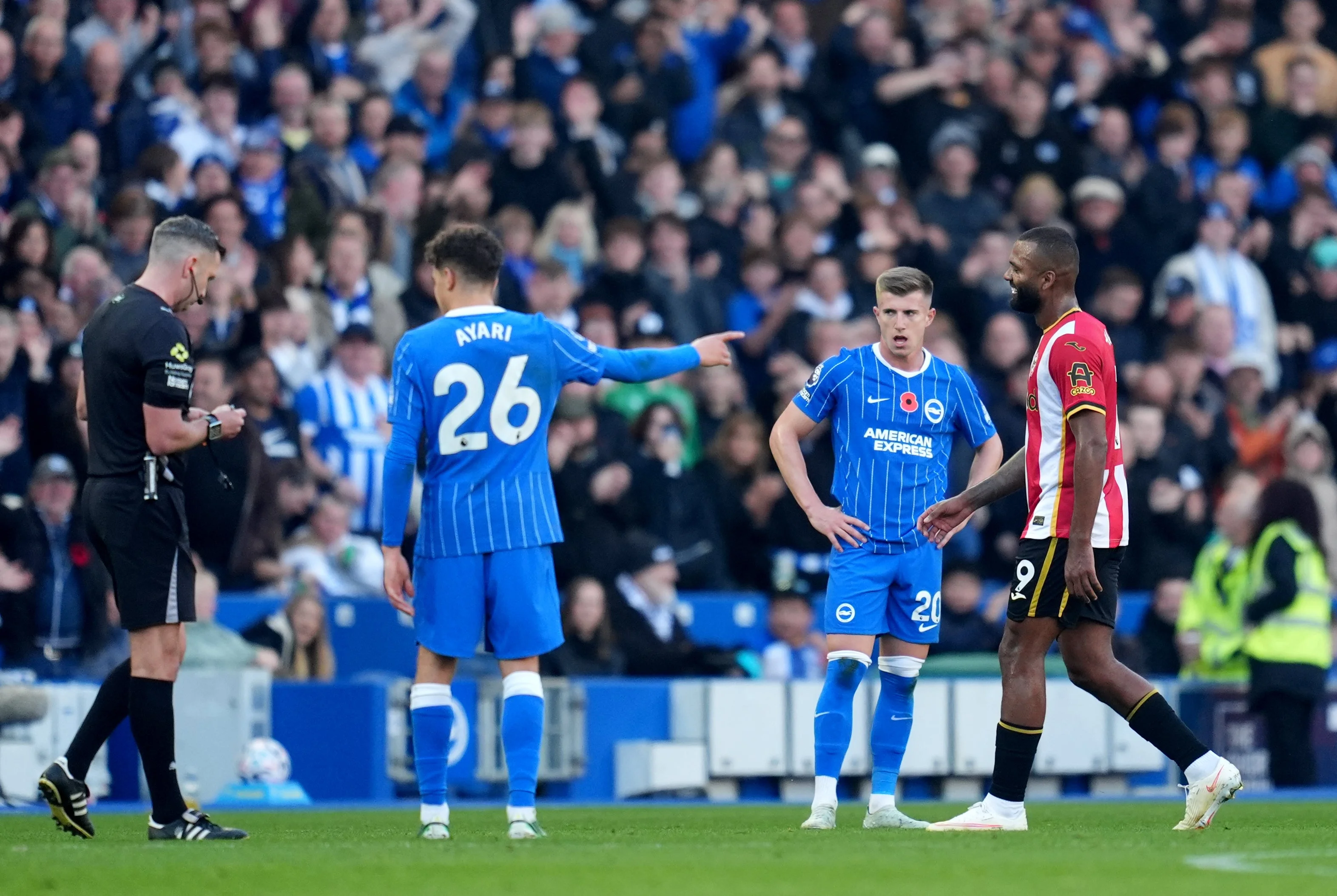
Thiago had earlier failed to trouble Brighton keeper Bart Verbruggen with a tame lob. His departure was followed by another setback for Brentford: Oliver awarded Brighton a penalty after Keane Lewis-Potter pulled Luka Vuskovic’s shirt following a corner. Gross converted emphatically into the top-right corner in the 42nd minute, giving Brighton a two-goal cushion before the interval.
For Brighton, the timing mattered. A penalty just before half-time let them carry a substantial advantage into the break, when Brentford had little time to answer on the pitch. For the visitors, the combination of a player down and a second goal conceded made a comeback substantially more difficult. Here’s the thing: the scoreline reflected two different turning points, Gomez’s quality and Brentford’s loss of control around the sending-off.
Brighton manage the second half
Brentford’s travelling supporters voiced their frustration, chanting “2-0 to the referee” and “Michael Oliver, it’s all about you”. Their team struggled to leave its own half for long spells after the break. The second half was subdued, with a few confrontations interrupting a match in which Brighton had the more comfortable position and Brentford had limited room to take risks.
There were still moments of friction. Brighton captain Lewis Dunk was booked for a challenge on Kevin Schade and argued with Brentford manager Keith Andrews. Schade later received a yellow card for shoving Vuskovic, then failed to connect cleanly with a Callum Wilson cross. Those incidents offered some tension, but they didn’t produce a sustained Brentford threat.
Five minutes of added time gave Brighton’s home crowd a brief reason for concern. Brentford couldn’t register a shot on target, however, and the score stayed 2-0. Brighton had found the early breakthrough, capitalised on the opportunity from the penalty spot, and then protected their advantage through a second half in which the visitors struggled to build attacks.
What the result says about Brighton
The win was Brighton’s seventh in 10 league matches this season, lifting them above Manchester City and into second place. Brentford stayed eighth on 14 points. Those positions give the result added weight, though one match doesn’t settle the larger questions about either club’s season. Brighton’s immediate achievement is more specific: they’ve maintained a strong league start despite a crowded run of fixtures and a difficult sequence of opponents.
If you’re working in this space, the useful detail is how Brighton turned control into a result without needing a constant stream of chances. Gomez’s strike gave them the lead, and Gross’s penalty made the margin safer; after that, the red card reduced Brentford’s capacity to impose a different pattern. Brighton’s performance wasn’t simply about dominating possession or creating repeated openings. It was about taking key chances and avoiding a late concession.
That said, the second-half control came against a side playing with ten men, so it’s hard to treat it as a standalone measure of Brighton’s attacking strength. The result still counts, and the schedule makes it a meaningful one. But the clearest test ahead will be whether Brighton can keep converting their strong league position into results as the demands of domestic and European football continue. A useful win, then—with a standout goal and a match-shaping dismissal at its centre.