A third award after a landmark Barcelona season
Alexia Putellas’ third Women’s Ballon d’Or recognizes a season in which Barcelona’s trophy haul and her own attacking output told a closely connected story. The 32-year-old midfielder won the award in London on Monday, becoming the first player to interrupt teammate Aitana Bonmati’s three-year winning run. That result gives Putellas a distinction of her own within a team that has supplied several of the sport’s leading players.
Putellas captained Barcelona to four trophies, including a third Champions League title in four years and a seventh straight Liga F crown. Those wins point to more than one successful campaign: they reflect a club able to keep competing for major honours across seasons. Putellas had already won the Ballon d’Or in 2021 and 2022, so this latest award also returns her to the top of an individual prize she’s won before, after Bonmati’s run.
The award’s significance rests partly on that combination. Putellas was recognised while playing for a side whose achievements could easily dominate the account of the season, yet her numbers give voters a clear individual case to consider. In football, team success and personal recognition aren’t cleanly separable; a captain’s influence is assessed in the same setting as the results around her. This is more significant than it looks: Putellas’ win makes room for a different Barcelona leader to define the latest chapter.
Production for club and country
Across all competitions last season, Putellas scored 21 goals and supplied 13 assists. Those figures describe a midfielder contributing directly to attacks in two ways, while also giving a sense of the scale of her involvement over a full campaign. They don’t, on their own, explain every part of her influence or how each contribution affected a match. But they do make the case that her award wasn’t built only on the honours won by Barcelona.
Her season also included six goals for Spain. The national side retained the UEFA Women’s Nations League title and qualified for next year’s World Cup in Brazil, giving Putellas another set of team achievements to add to her club season. For a player moving between club and country, the demands and contexts differ; the same goal tally can’t tell the whole story of either setting. Still, her scoring record across both gives the award a broader basis than Barcelona’s silverware alone.
That said, the article’s figures offer a snapshot, not a full statistical profile. They don’t break down minutes, roles, or the circumstances behind individual goals and assists. A careful reading should treat them as evidence of output, rather than a complete measure of performance. Here’s the thing: awards often compress a long season into a single result, while the work behind that result is spread across competitions, teammates, and changing match situations.
A team achievement, in her view
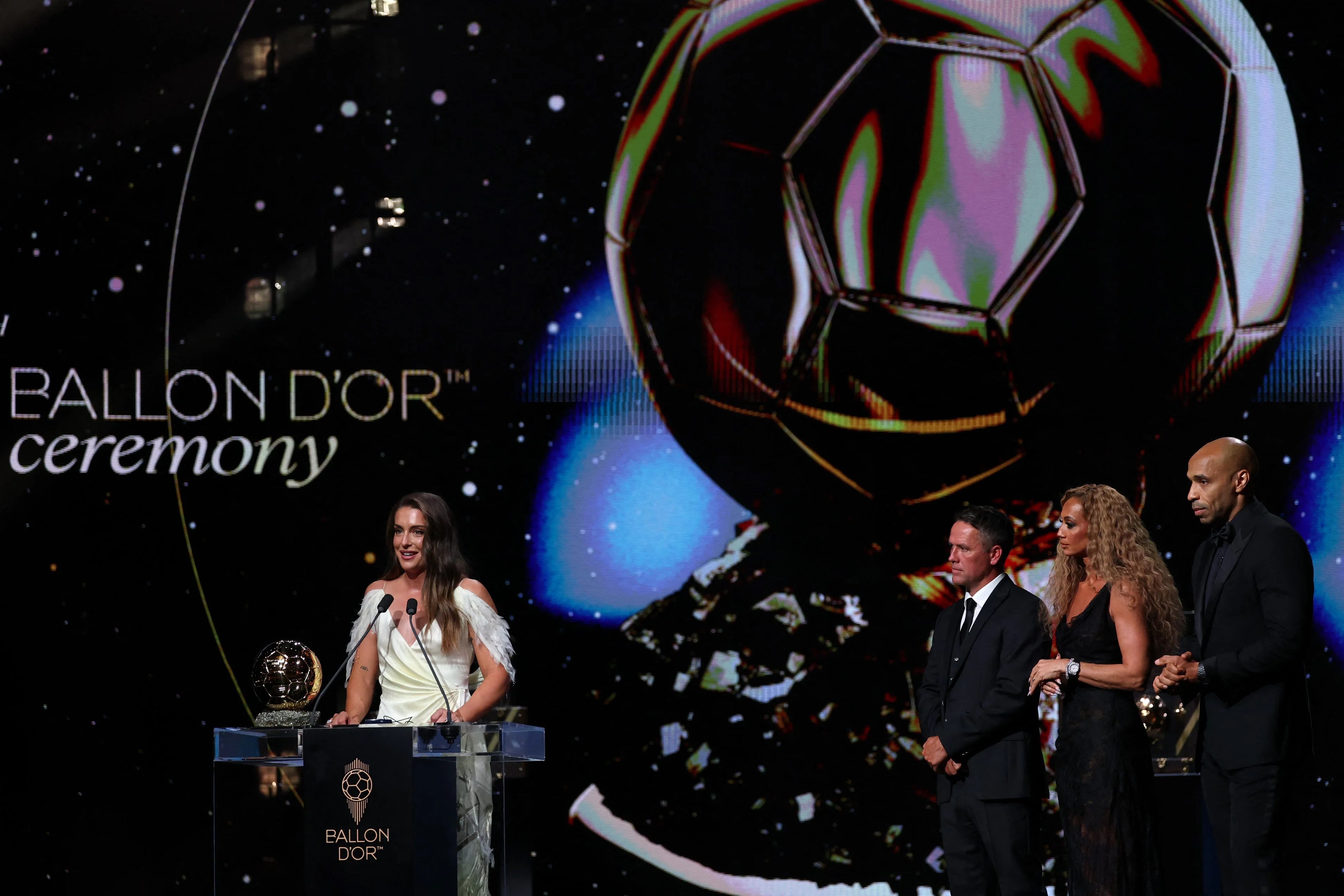
Putellas used her acceptance speech to credit Barcelona’s squad, noting that several teammates were also among the nominees. She described the season as a collective effort shaped by memorable performances and challenges, including injuries and unexpected setbacks. That framing matters: an individual award can invite a story of personal dominance, but Putellas pointed back to the conditions that made the team’s season possible.
“It was a great pleasure to play alongside each and every one of you,” she said. “We had some incredible experiences as a team.” She also thanked France Football and those who judged her deserving of the award. The remarks place the honour within a shared season, while acknowledging the people responsible for selecting the winner.
Her message to young players was direct: “If you want to play football, play football. Doesn’t matter if you are a boy or a girl, where you come from, don’t listen to someone who says you can’t do it.” She urged them to believe in their ambitions and pursue them with “love and passion.” The advice speaks to access and persistence without turning the award ceremony into a claim that barriers have disappeared. A clear message. And one aimed well beyond the room in London.
Spain’s presence on the shortlist
Spain had six players on the women’s Ballon d’Or shortlist, more than any other country. England’s only representatives among the 30 nominees were Alessia Russo and Alex Greenwood. Those figures show how strongly Spanish players featured in this year’s group, though a shortlist alone can’t explain the wider strength of a national team or the reasons individual players were selected.
The presence of six Spanish nominees also gives Putellas’ win a wider context: she was recognised from within a field that included several players from her own country. Her speech’s emphasis on teammates fits that picture, even as the award singles out one person. If you’re working in this space, that tension is familiar: elite team performance can raise the profile of multiple players, while the award itself still requires a single winner.
A new league, and a change in chapter
After the season, Putellas moved to the Women’s Super League to join London City Lionesses. The transfer shifts the setting for the three-time winner, whose latest award marks the close of her Barcelona captaincy chapter. It’s a notable change in the career described here, but the source doesn’t establish what her role or results in England will be. Those will depend on what happens after the move.
For now, the award closes one season and opens a new stage in another competition. Putellas arrives with three Ballon d’Or titles, a record of success with Barcelona, and contributions for Spain that include six goals during a campaign of national achievement. Her next test will be adapting to a different club environment, while the broader question for readers is how much of her Barcelona influence will travel with her. The answer will come through her performances, not the trophy count she brings with her.
Putellas’ award caps a season defined by Barcelona’s record-setting consistency and her contributions for club and country. Her move to England now puts the three-time winner in a new league, with the latest Ballon d’Or marking the close of her Barcelona captaincy chapter. The numbers here are strong, but the award’s lasting meaning will depend on what she does next and how her new team develops around her.