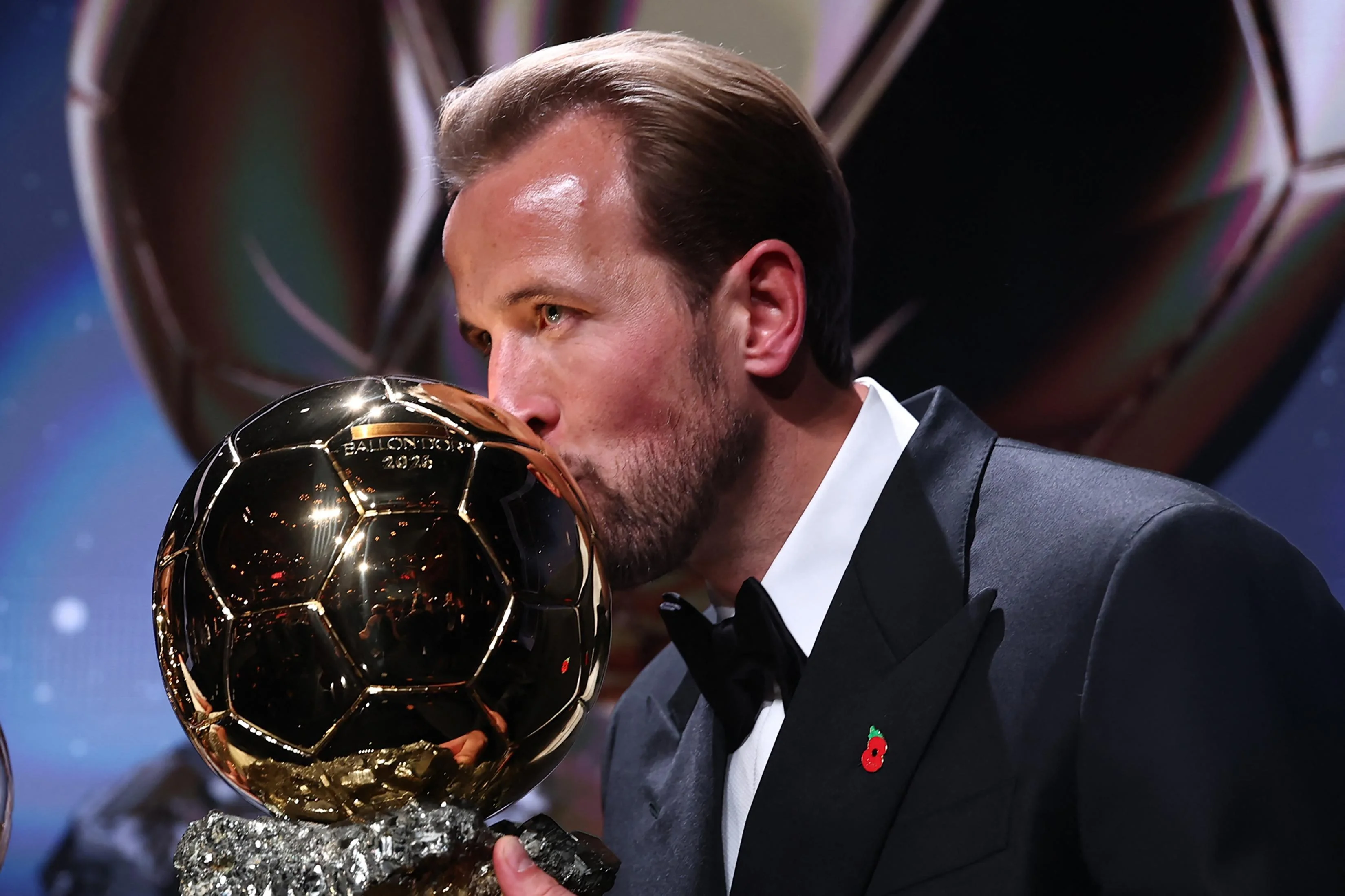
Kane credits the clubs behind his progress
Harry Kane used his Ballon d’Or acceptance speech to recognize the clubs that shaped his career, giving Tottenham Hotspur credit for helping him develop and Bayern Munich credit for accelerating his progress since he joined. The remarks cast the award as a personal milestone with a longer backstory: players may receive individual honors, but their work is formed inside teams, with coaches, teammates, staff and supporters contributing to the environment around them. Kane’s choice to name both clubs also gives the speech a career-spanning frame, connecting the development he associates with Tottenham to the growth he says he’s experienced at Bayern.
That distinction matters. A player can acknowledge a former club for laying foundations while crediting a current one for the conditions in which further progress has taken place. Kane didn’t present the two contributions as competing claims. Instead, his remarks recognize different stages of a career, and the different people and institutions involved at each stage. It’s a measured way to accept a major individual prize: take the honor, but make clear that the work behind it wasn’t done alone.
His Bayern comments put development in personal terms
“Since joining the club, I’ve improved tremendously, not only as a player, but also as a person and as a leader,” Kane said, according to @iMiaSanMia. He thanked Bayern’s management, including those unable to attend, and called it a privilege to represent the club. The statement is brief, but it describes progress across three dimensions: football, personal growth and leadership. That breadth makes his praise more specific than a routine expression of gratitude, even if the speech doesn’t spell out the particular experiences behind it.
There’s a useful distinction here between becoming a better player and taking on a larger role within a team. At clubs with high expectations, leadership can mean setting standards in training, helping teammates stay composed, or carrying responsibility when results and performances are under scrutiny. Those are general demands of elite football, not details Kane supplied about his own experience. His wording leaves the specifics open, but it signals that he sees his time at Bayern as affecting how he operates beyond the technical side of the game.
And this is the part most people overlook: thanking a club’s management, including people who couldn’t attend, also recognizes the work that sits outside the public spotlight. A player’s development isn’t shaped by one speech or one match. It depends on sustained contact with the people who organize a club and support its team, though Kane’s remarks don’t identify particular decisions or individuals.
An individual award, built inside a team
Kane said he was proud to bring the trophy back to Munich. He also singled out his teammates, coaches and supporters during the speech. Those acknowledgments frame the award as a personal achievement built with help across the club, from its leadership to its fans. That framing is familiar in team sports, where individual recognition can put one person at the center of attention even though performance depends on coordination across a much larger group.
The speech’s emphasis on collective contribution doesn’t make the award less personal. It clarifies what Kane believes the recognition represents. A player’s performance is visible on the pitch, while the preparation and support around it are harder for an audience to see. Coaches help shape how a team plays; teammates create the conditions for shared work; supporters provide the club with a public identity and a following. Kane’s thanks draw those pieces into the account of his achievement without claiming that they all played the same role.
The numbers here are underwhelming in one sense: the available remarks offer no detail about the scale or mechanics of the improvement Kane describes. But the point of an acceptance speech isn’t necessarily to provide that kind of accounting. Its value is in showing how the recipient understands the honor. In Kane’s telling, the trophy belongs to him, yet its meaning reaches back to the clubs and people he credits with helping him get there.
What the remarks say about Bayern’s role
Kane’s praise for Bayern is notable because it describes the club as a place where progress has continued, rather than simply as the team he currently represents. He says his time there has accelerated that progress, and he links the change to both footballing and personal development. That’s a clear statement of how he views the move’s effect on his career. The speech doesn’t establish which parts of the club’s methods or culture produced that effect, so readers shouldn’t treat the remarks as a detailed assessment of Bayern’s development system.
For a club, public recognition from a player at an awards ceremony carries reputational value. It presents the organization as more than an employer or a backdrop to individual success: in Kane’s account, Bayern has contributed to his growth. That’s meaningful, but it’s still one player’s account, delivered in the setting of a thank-you speech. Its sincerity and its public-facing purpose can coexist. A careful reading takes the praise seriously while keeping its limits in view.
If you’re working in this space, the contrast Kane draws between development at Tottenham and progress at Bayern offers a useful reminder that player growth can span clubs and roles. A move doesn’t erase the contribution of the previous team, and gratitude to a current club doesn’t require rewriting the past. The speech’s strongest point is its refusal to assign a career’s development to a single institution.
The wider significance of the speech
This is more significant than it looks. Acceptance speeches can become short exercises in name-checking, but Kane’s remarks offer a simple account of how he connects recognition to development: Tottenham helped shape him; Bayern has helped him progress; and the people around both clubs belong in the story. He doesn’t claim that every contribution can be measured, or that the trophy settles any debate about his career. He uses the moment to explain what he values about the path behind it.
That said, the speech is a snapshot, not a full career analysis. It doesn’t provide examples of how Kane changed as a player, what leadership means in his day-to-day work, or how teammates and coaches influenced him. Those gaps shouldn’t be filled with invented detail. The most defensible reading is also the most direct: Kane sees his individual honor as connected to the clubs that helped him develop, and he chose to say so publicly.
A collective achievement, in a personal spotlight. That tension is part of what makes the remarks worth considering. The trophy will be associated with Kane, but his account of its meaning extends beyond him—to the teams, leaders, coaches, teammates and supporters he thanked.
Join the conversation!
Sign up for a user account and get:
- New, improved notifications system!
- Fewer ads
- Create community posts
- Comment on articles, community posts
- Rec comments, community posts