Infantino’s ‘eligibility’ crisis intensifies as Nigeria considers suing, while those he flatters look deceived
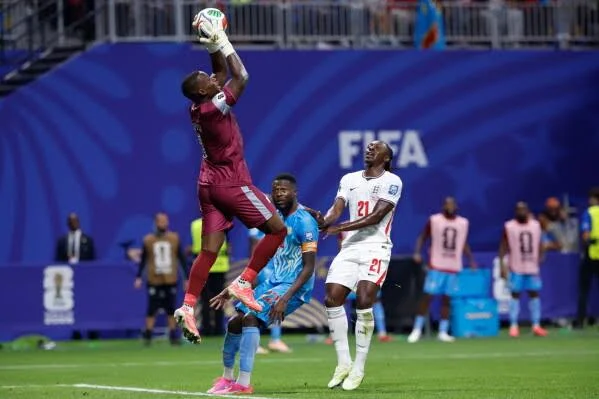
October 7 – FIFA and its president Gianni Infantino’s ability to protect the sporting integrity of its biggest competitions has once again been called into question following the World Cup eligibility scandal surrounding Congo DR goalkeeper Lionel Mpasi.
Mapsi featured at the World Cup last summer and helped Congo reach the round of 32 where they lost to England in a game in which Mpasi was outstanding. FIFA lawyers reportedly knew in March, three months before the World Cup kicked off, that Mpasi was ineligible to play for Congo.
FIFA actually knew that Congo was fielding illegible players in World Cup qualification as far back as December 2025 when Nigeria filed an official complaint to FIFA claiming Congo used between six and nine ineligible players in their World Cup 2026 qualifying campaign.
In African qualifying Congo beat Nigeria 4-3 on penalties to secure their spot in the intercontinental play-offs for 2026. In the play-off Congo beat Jamaica.
See: Nigeria seek World Cup 2026 lifeline with Congo ineligibility complaint
Cameroon have also previously filed a complaint to FIFA about ineligible Congo players, arguing that players who were born in Europe had not been properly cleared to switch nationalities.
At the World Cup Congo’s team was stuffed full of players from Europe.
Infantino critics argue that turning a blind eye to Congo’s ineligible player shows a clear pattern of Infantino’s consistent readiness to overlook FIFA’s rules and the competitive integrity of FIFA’s competitions in favour of helping ‘friends and allies’ out.
The most obvious example during the World Cup was the Balogun red card, which was overturned following a telephone conversation between US president Donald Trump and Infantino.
That FIFA knew and overlooked the ineligibility of Congo’s goalkeeper is undeniable. FIFA has denied that the reason for overlooking the eligibility has anything to do with supporting new Congo president Veron Mosengo-Omba.
A long-term ally and associate of Infantino, who followed him from UEFA to FIFA, Mosengo-Omba was one of Infantino’s loyal storm troopers in bringing Africa’s federations to heel, later becoming general secretary.
Mosengo-Omba was then aged out of the role but a deal was struck with the Congo sports ministry to insert him into the presidency of the national federation. FIFA said it “strongly rejects these unfounded allegations” around the eligibility of Mpasi, as well as saying that Infantino had no role in any decisions.
Even so, with Infantino’s increasingly public track record to date, and with new scandals engulfing his presidency almost daily, the legal principle of ‘appearance of bias’ is impossible to dismiss when looking at the Congo case.
The Confederation of African Football (CAF) has yet to make any comment on the case, even though Nigeria, one of its senior and most storied members, was affected by the decision.
Concacaf, whose member association Jamaica was also impacted, emphasised the importance of player eligibility and the consistent and fair application of regulations,
“Concacaf takes player eligibility matters very seriously and expects the applicable regulations and procedures to be applied consistently and fairly in all competitions. Any concerns regarding player eligibility, particularly those that may affect the integrity of a competition or the interests of one of our Member Associations, should be thoroughly reviewed and addressed through FIFA’s appropriate governance and disciplinary bodies, in accordance with established regulations and due process,” said a Concacaf statement.
Calls for compensation
That Congo would appear to have been given a major competitive advantage, is ironic considering that Nigeria has been a solid and reliable supporter of Infantino from before his election, and on every step of his African conquest.
A Nigerian National Sports Commission official told ESPN that it could seek damages from FIFA. “Nothing has been decided yet, but we will seriously consider seeking compensation from FIFA for all of the economic losses this has cost Nigeria,” an NSC official said.
“The revenue that the Super Eagles and the NFF would have received from participating at the World Cup, the exposure that players would have got, transfers, the sponsorship fees, even the boost to the Nigerian economy.
“We are exploring all our options as a country and nothing is off the table.”
Jamaica were one match closer to the finals than Nigeria and have even more reason to feel aggrieved at missing out on a World Cup finals hosted in their confederation.
What is an even bigger snub for the Jamaicans and their president Michael Ricketts will be the realisation that within this FIFA, decisions that gives other nations a competitive advantage over them reinforces the perception that they are a second class citizen.
That realisation will not be eased by the events of two weeks ago when Ricketts rolled out the red carpet for Infantino in Jamaica for the opening of their Nations League campaign as Infantino began his election campaigning. Ricketts also facilitated a number of other Caribbean FA presidents to be at the match and receive the Infantino pitch.
Ricketts was effusively supportive of Infantino but has now been left looking like Jamaica and the Caribbean’s equivalent of the village idiot (the Jamaican word is Cunumunu) by Infantino’s leadership on the Congo case.
Ricketts has sided with Infantino’s promises of more grant money at whatever cost to future football generations. Jamaica would have earned a minimum $14.5 million (with no FIFA Forward strings attached) from the World Cup if they had qualified via a fair and transparent application of the competition rules.
Contact the writer of this story at [email protected]